

Vaginal pH balance is one of those phrases that sounds like a chemistry exam and feels like something we're not supposed to talk about. Let's do both anyway, gently.
Your vagina has its own ecosystem, and it runs slightly acidic on purpose. Knowing the normal range, what keeps it there, and what can nudge it around is honestly one of the most useful things I've learned as a woman. Nobody taught us this in school. So here it is.
What is vaginal pH, and what's a normal range?
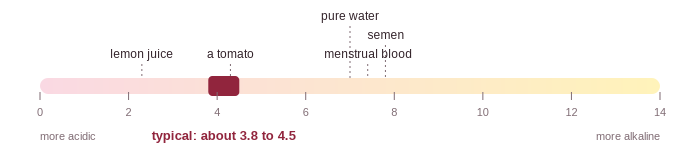
pH is a 0 to 14 scale of how acidic or alkaline something is. Seven is neutral (pure water). Lower numbers are more acidic.
For most women in their reproductive years, vaginal pH sits around 3.8 to 4.52, 3. For comparison, that's close to a tomato. Mildly acidic, and that's exactly how it's supposed to be.
Before puberty and after menopause, when estrogen is lower, vaginal pH is naturally higher (less acidic), often above 4.51. So "normal" also depends on your stage of life.
Where a typical vaginal pH sits
Mildly acidic, close to a tomato. Higher before puberty and after menopause.
Why is a healthy vaginal pH balance acidic?
Because of your resident bacteria.
In most reproductive-age women, the vaginal microbiome is dominated by Lactobacillus species. In a landmark 2011 study that mapped the vaginal communities of nearly 400 women, most were led by one of four Lactobacillus species (L. crispatus, L. iners, L. gasseri or L. jensenii), and those Lactobacillus-dominant communities had the lowest pH, averaging roughly 4.0 to 4.7 depending on the species2.
These good bacteria feed on glycogen that estrogen helps deposit in the vaginal lining and turn it into lactic acid. The lactic acid is what keeps the pH low3, 7. Estrogen, glycogen, Lactobacillus, acid. That's the whole loop, and it's why pH changes when hormones change.
Some women's communities are more diverse and less Lactobacillus-dominant, with a higher pH, without any symptoms at all2. Normal has a range. The point is less about hitting a number and more about what feels typical for you.
The whole loop
Estrogen, glycogen, Lactobacillus, acid. That is why pH moves when hormones move.
deposits glycogen in the lining
food for Lactobacillus
turns it into lactic acid
keeps the pH low
What can affect vaginal pH?
Here's where everyday life comes in. None of these are "bad," they're just worth knowing.
Your period. Menstrual blood has a pH around 7.4, so pH tends to rise during your period and settle back afterward3.
Sex. Semen is alkaline (about pH 7.2 to 8), so pH can go up temporarily after unprotected sex3.
Douching and scented products. Douching, scented washes, sprays and wipes can wash away or disrupt Lactobacillus. ACOG and other major bodies advise against douching for exactly this reason1, 4. The vagina cleans itself; it only needs water (and a gentle, unscented cleanser for the outside, if you like).
Antibiotics. They don't tell good bacteria apart from the ones they're targeting, so a course of antibiotics can disturb the balance of bacteria down there for a while, which is one reason yeast infections sometimes follow a course of antibiotics5, 8.
Hormonal shifts. Pregnancy, breastfeeding, perimenopause, menopause and some contraceptives change estrogen levels, which changes glycogen, which changes what Lactobacillus has to work with1, 2.
Heat, sweat and tight clothes. Not a direct pH changer, but Manila heat plus synthetic underwear plus a long commute creates a warm, damp environment that's less kind to the balance down there. Breathable cotton and changing out of sweaty gym wear help.
What can nudge it
Mostly temporary, all worth knowing.
 Your period
Blood is about pH 7.4, so pH rises, then settles.
 Sex
Semen is alkaline, so a temporary rise.
 Douching, scented products
Can wash away or disrupt Lactobacillus.
 Antibiotics
Do not spare the good bacteria.
 Hormonal shifts
Pregnancy, breastfeeding, menopause, some contraceptives.
 Heat and damp clothes
Not a direct pH change, but less kind to the balance.
What are the signs vaginal pH may be off?
A pH change by itself has no feeling. What you'd notice are the things that can come with it. The most common is bacterial vaginosis (BV), which is linked to a drop in Lactobacillus and a rise in pH above 4.55. Signs can include:
- A thin gray or white discharge
- A fishy smell, especially after sex
- Sometimes nothing at all; BV often has no symptoms
Yeast infections, on the other hand, usually happen at a normal pH, with thick white discharge and itching. Different thing, different care5. Either way, these are reasons to see a doctor, not reasons to buy a product.
What helps keep things typical down there?
You can't set your pH like a thermostat, and no supplement, wash or wipe should promise that. What you can do is look after the conditions your good bacteria like, which is what keeps things typical in the first place.
- Skip douching and scented products inside or near the vulva1, 4.
- Use water or a mild, unscented wash on the outside only.
- Wear breathable underwear and change out of damp clothes (many OB-GYNs suggest cotton).
- Pee after sex and keep up basic hygiene, the simple habits most OB-GYNs recommend (we cover the whole routine in Feminine Hygiene: Everyday Habits for Vaginal Health).
- Look after your gut too. Some women add a daily Lactobacillus probiotic to their routine as a habit. It's not a pH fix, and it doesn't replace seeing your doctor (more in Probiotics for Women).
Questions, answered
What is a normal vaginal pH?
About 3.8 to 4.5 in the reproductive years. It's naturally higher before puberty and after menopause, when estrogen is lower.
Can I check my vaginal pH at home?
Test strips are sold at drugstores and online, but a number alone can't diagnose anything, and normal has a range. If you have symptoms, see your OB-GYN instead of self-testing.
Does diet affect vaginal pH?
There's no strong evidence that specific foods change vaginal pH directly. Overall health, hormones and your Lactobacillus matter more than any single food.
Can probiotics change my vaginal pH?
No product should claim to set your pH. Research on certain oral Lactobacillus strains is early and strain-specific6, so think of a probiotic as a daily habit, not a pH tool.
Why does my vaginal pH go up after sex or my period?
Semen and menstrual blood are both more alkaline than the vagina, so pH rises temporarily and usually settles back as Lactobacillus does its thing.
xo, NicoleNicole Borromeo, Founder, Popelle
References
- ACOG (American College of Obstetricians and Gynecologists). Vulvovaginal Health (patient FAQ), acog.org/womens-health/faqs/vulvovaginal-health, and Vaginitis (patient FAQ), acog.org/womens-health/faqs/vaginitis.
- Ravel J, et al. Vaginal microbiome of reproductive-age women. Proc Natl Acad Sci USA. 2011;108(Suppl 1):4680-4687.
- Lin YP, et al. Vaginal pH value for clinical diagnosis and treatment of common vaginitis. Diagnostics (Basel). 2021;11(11):1996.
- Martino JL, Vermund SH. Vaginal douching: evidence for risks or benefits to women's health. Epidemiol Rev. 2002;24(2):109-124.
- CDC. Bacterial Vaginosis and Vulvovaginal Candidiasis. Sexually Transmitted Infections Treatment Guidelines, 2021. cdc.gov.
- Reid G, Charbonneau D, Erb J, et al. Oral use of Lactobacillus rhamnosus GR-1 and L. fermentum RC-14 significantly alters vaginal flora: randomized, placebo-controlled trial in 64 healthy women. FEMS Immunol Med Microbiol. 2003;35(2):131-134.
- Mirmonsef P, et al. Free glycogen in vaginal fluids is associated with Lactobacillus colonization and low vaginal pH. PLoS One. 2014;9(7):e102467.
- Mayo Clinic. Yeast infection (vaginal): Symptoms and causes. mayoclinic.org.