
How to choose a probiotic in the Philippines is a different question from how to choose one anywhere else. Our heat, our shipping, our marketplaces, our FDA. A box that's perfect for a pharmacy shelf in a cold country may have spent three days in a courier van in 34-degree weather before it reached your door in Quezon City.
So this is the guide I wish I'd had: how to read a probiotic label, what the PH FDA markings mean, and how to buy without getting burned.
Step 1: Check the PH FDA
In the Philippines, probiotics sold as supplements are regulated by the Food and Drug Administration as food supplements, not medicines1. (Probiotics themselves are defined as live microorganisms that, in adequate amounts, confer a health benefit3.) Two things to look for:
- The compliance line. Food supplements sold in the Philippines are required to carry the statement "FOOD SUPPLEMENT. NO APPROVED THERAPEUTIC CLAIMS." (or the Filipino version, "Mahalagang paalala: Ang [brand] ay hindi gamot at hindi dapat gamiting panggamot sa anumang uri ng sakit.")1. If a product promises to cure or treat anything, that's a red flag, not a feature.
- Verifiable on the FDA portal. The FDA runs an online verification portal that lists both licensed establishments (the company's License to Operate) and registered products2. Search the brand or product name. Thirty seconds, and it filters out a surprising amount of what's on marketplaces. A registration is not an endorsement of what a product does; it means the product and company went through the FDA's process.
A product can be legit and still make honest, limited claims ("supports," "contributes to"). What it can't do is promise outcomes. That's the rule for every brand here, including mine.
Two things to look for on any box
The compliance line, and a brand you can find on the FDA portal.
 1 · Printed on the front of every Popelle box
Required on every food supplement sold in the Philippines. A box that promises to cure or treat is a red flag.
Search the product or company on the FDA portal before you buy.
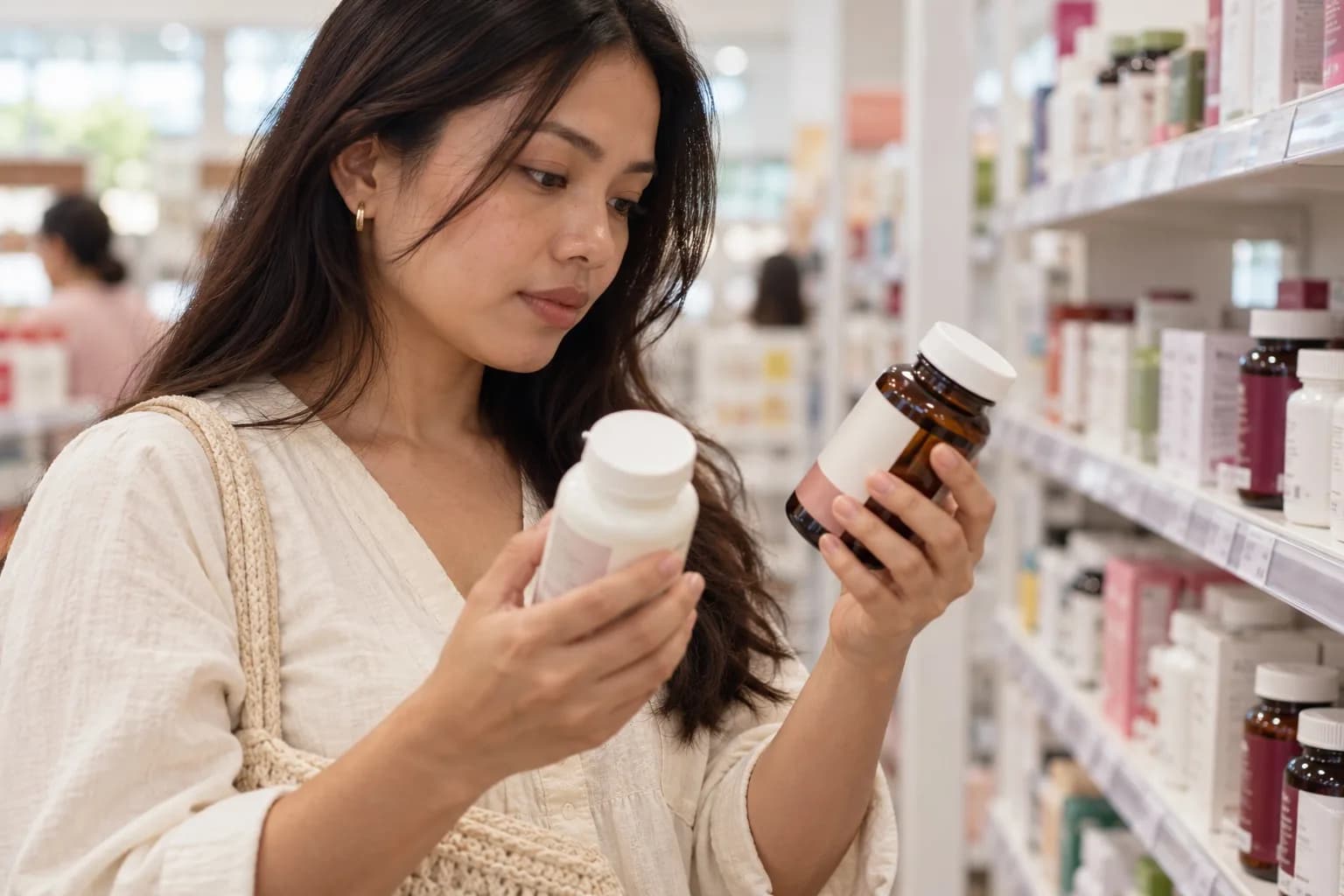
Step 2: Read the strains
"Probiotic" on the front of the box tells you almost nothing. The back does.
- Look for named species, written as a genus and species: Lactobacillus crispatus, Lactobacillus gasseri, Bifidobacterium lactis. "Proprietary probiotic blend" with no names means you can't check what you're buying.
- Match the species to what you want. For a women's formula, that usually means Lactobacillus species found in the vaginal microbiome (L. crispatus, L. gasseri, L. rhamnosus, L. reuteri) alongside general gut species. One label-reading tip: since a 2020 renaming, some labels write L. rhamnosus as Lacticaseibacillus rhamnosus and L. reuteri as Limosilactobacillus reuteri. Same bacteria, longer names. We break this down in Probiotics for Women.
- Strain codes are a bonus. Some brands list the exact strain (letters and numbers after the species). Research is done at that level, so it's the most transparent a label can be.
Step 3: Read the CFU, and ask "at when?"
CFU (colony-forming units) is the count of live bacteria per serving. Two questions:
- How many? Products range from a few billion to 50 billion or more. More isn't automatically better. A sensible count with the right species beats a huge number of the wrong ones.
- At manufacture or at expiry? Live bacteria decline over time, especially in heat. A label that guarantees CFU "at end of shelf life" or "through expiry" is telling you more than one that counts at the factory door.
Step 4: Check the sugar and the extras
Sugar varies a lot between formats, so flip the box and read grams of sugar per serving. Some gummy formats carry several grams each, and a daily stack can add up fast.
Also scan for synthetic dyes, allergens, and whether it's vegetarian or gluten-free if that matters to you.
Step 5: Think about heat and shipping
This is the Philippine-specific step. Many probiotics are formulated to need refrigeration, and a product like that doesn't love a courier bag in Manila traffic.
- Shelf-stable formats (ones that don't require refrigeration) are the practical choice here. Check the storage instructions on the box.
- Single-serve packaging (sachets, blister packs) may protect each dose from humidity better than a jar you open thirty times.
- Be careful with gummies. Probiotic gummies are often more susceptible to heat damage than dry formats, and a gummy that has softened in transit may have lost a lot of its live cultures on the way. Unless you're certain how they were stored and shipped, skip them.
- Store it sensibly once it's home: a drawer or cupboard, not the car or a sunny windowsill.
- Check the expiry date on arrival. If a seller shipped you something expiring next month, that's a return.
A quick heat check before you add to cart
What travels well in Philippine weather, and what to think twice about.
 Travels well
- Shelf-stable formats that need no fridge (check the box)
- Single-serve sachets or blister packs
- Storage instructions printed clearly on the pack
 Think twice
- "Keep refrigerated" products shipped without a cold pack
- Gummies, which soften in the heat
- Big jars opened every day in a humid kitchen
Step 6: Buy from the right place
Shopee, Lazada and TikTok Shop are wonderful and also full of resellers, parallel imports and the occasional fake.
- Buy from the brand's official store on the marketplace (look for the official or mall badge) or its own website.
- Be wary of prices far below everyone else's. Expired stock and counterfeits are how those prices happen.
- Check the packaging on arrival: intact seals, a batch number, an expiry date, the FDA compliance line, and a Philippine distributor's name on the label.
- Read the reviews with photos, not the star count.
Buying online
Shopee, Lazada and TikTok Shop are wonderful, and full of resellers.
 Green flags
- Official store or mall badge, or the brand's own site
- Intact seals, batch number, expiry date
- The FDA compliance line and a PH distributor on the label
- Reviews with photos
 Red flags
- Prices far below everyone else's
- Stock expiring next month
- No named strains on the back
- Promises to cure or treat anything
Step 7: Pick the format you'll actually take
The best probiotic in the Philippines is the one you'll take every day. If you hate swallowing capsules, don't buy capsules. If you forget bottles, buy something that fits in your bag. A format you look forward to beats a format you tolerate. (More on building the habit in When Is the Best Time to Take Probiotics?.)
The seven-step checklist
Save this one.
 Check the PH FDA
Compliance line, verifiable brand.
 Read the strains
Named species, not a blend.
 Read the CFU
And ask "at when?"
 Check the sugar
Grams per serving.
 Heat and shipping
Shelf-stable, single-serve.
 Buy from the right place
Official stores only.
 Pick a format you'll take
Daily beats perfect.
 That's it
Everything else is marketing.
Questions, answered
Are probiotics FDA approved in the Philippines?
Probiotic supplements are regulated by the PH FDA as food supplements, which are registered rather than "approved" the way medicines are. A registration is not an endorsement of what a product does. Look for the "FOOD SUPPLEMENT. NO APPROVED THERAPEUTIC CLAIMS." line and verify the product or company on the FDA's online portal.
What is the best probiotic in the Philippines?
There's no single best. The right one has named strains that match your goal, a sensible CFU, low sugar, a format that survives heat and shipping, an FDA-verifiable brand, and a routine you'll keep.
Do probiotics need to be refrigerated in the Philippines?
Some do, some don't. Check the storage line on the box. Shelf-stable formats are the practical choice for Philippine heat and courier delivery.
Where is it safe to buy probiotics online in the Philippines?
From the brand's official website or its official (badged) store on Shopee, Lazada or TikTok Shop. Check seals, batch and expiry on arrival, and be wary of prices far below the brand's own.
How much CFU do I need?
There's no universal number. Many products sit in the billions-per-serving range. Focus on the species and whether the count is guaranteed through expiry rather than chasing the biggest figure.
xo, NicoleNicole Borromeo, Founder, Popelle
References
- Department of Health (Philippines). Administrative Order No. 2010-0008 (source of the "No Approved Therapeutic Claims" statement) and FDA Administrative Order No. 2014-0030 (labeling of prepackaged food). The Filipino wording comes from a later FDA directive on the phrase, whose number counsel should confirm. fda.gov.ph.
- Philippine Food and Drug Administration. FDA Verification Portal. verification.fda.gov.ph.
- Hill C, et al. The International Scientific Association for Probiotics and Prebiotics consensus statement on the scope and appropriate use of the term probiotic. Nat Rev Gastroenterol Hepatol. 2014;11(8):506-514.