
The best time to take probiotics is one of those questions with a satisfying answer and a slightly annoying one. The satisfying answer: there is a time that research suggests is a little better. The annoying one: it matters far less than whether you take them at all.
I say that as someone who owned three half-finished bottles (two from Shopee, one from a drugstore run) before Popelle existed. So let's cover what the research says about timing, then the part that actually changes things: how to make it a habit you keep.
When is the best time to take probiotics, and does it matter?
A little, yes. Probiotics are live bacteria, and the trip from your mouth to your intestines runs through stomach acid. The question is how many survive the journey.
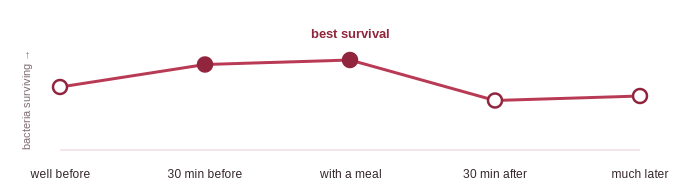
A 2011 lab study used a model of the human stomach and upper gut to test this. Researchers ran the same probiotic through it at different times relative to a meal and measured how many bacteria survived. Survival was best when the probiotic went in with a meal or up to 30 minutes before it, and worse 30 minutes after eating. A meal of oatmeal with milk did better than water or apple juice alone, and the authors noted that a meal with some fat seemed to help most1.
Why? Food seems to buffer stomach acid, which may help more bacteria get through1. So "with or just before breakfast" is a reasonable default for most probiotics.
One honest caveat: that's one study, in a lab model, with one formulation. The bigger picture is that studies on probiotics generally test daily use over weeks, whatever the hour. The label on your product is the best guide for that specific formula.
When a probiotic survives the stomach best
One lab model of the upper gut, one formulation (Tompkins 2011).
Should you take probiotics in the morning or at night?
There's no strong evidence that morning beats night or the other way around. What the research supports is consistency, and what real life supports is picking a moment that already exists in your day.
- Morning people: with breakfast, or right after you brush your teeth, before the commute swallows you.
- Night people: with dinner, or as part of your skincare routine. The bacteria don't care that it's 11 p.m.
- Girls on the go: keep it in your bag and take it with whatever meal happens first, even if that's a Grab-side pandesal.
Pick one. Then stop thinking about it.
Can you take probiotics with antibiotics?
You can, and this is the one timing question where spacing is worth doing on purpose.
Antibiotics don't distinguish between the bacteria they're targeting and the friendly ones, so taking a probiotic at the exact same moment means some of it gets wiped out on arrival. The common advice from pharmacists is to leave a gap of a few hours between the antibiotic and the probiotic, and some providers suggest continuing the probiotic for a while after the course ends3. Ask your doctor or pharmacist for the spacing that fits your prescription.
Spacing a probiotic from an antibiotic
Common pharmacist advice. Ask yours for the spacing that fits your prescription.

How do you actually remember to take probiotics every day?
This is the real question, because every bottle in my drawer was a timing plan that failed. What worked:
- Anchor it to something you already do. Habit research shows new routines stick when they're attached to an existing cue: after coffee, after brushing, when you sit down to lunch4. "Every morning" is vague. "After I pour my coffee" is a plan.
- Keep it where the cue happens. On the kitchen counter, in your makeup pouch, next to your toothbrush. Not in a drawer.
- Make it easy. The same research found that simpler actions (like a glass of water) became automatic faster than more demanding ones4. No water, no swallowing, nothing to wash down keeps it simple.
- Make it a little nice. A ritual you look forward to is a ritual you keep. This is the whole reason Popelle pops.
- Don't quit over a missed day. Missing one day didn't derail habit formation in the research4. Just take it the next day.
Habits take time. In one well-known study, the median was about 66 days for a new daily habit to feel automatic, with a wide range between people4. Give yourself a month before you decide if the habit is sticking.
Lally 2010, with a wide range between people. Give any new routine a month.
Questions, answered
Should I take probiotics on an empty stomach?
Research suggests survival is better with or just before a meal than on an empty stomach, because food buffers stomach acid. Some products are formulated for empty-stomach use, so check your label.
Is it better to take probiotics at night?
There's no strong evidence that night beats morning. Choose the time you'll stick to. Consistency is the sweet spot.
How long should I take probiotics?
Trials typically ran for weeks to months of daily use. Think of it as a daily habit rather than a short course, and give any new routine at least a month.
Can I take probiotics while on antibiotics?
Yes, with a gap of a few hours between the two, and ask your doctor or pharmacist about the spacing. Many people continue the probiotic for a while after the antibiotic course ends.
What if I miss a day?
Take it the next day. Missing one dose doesn't undo a habit; stopping does.
xo, NicoleNicole Borromeo, Founder, Popelle
References
- Tompkins TA, Mainville I, Arcand Y. The impact of meals on a probiotic during transit through a model of the human upper gastrointestinal tract. Benef Microbes. 2011;2(4):295-303.
- Hill C, et al. The International Scientific Association for Probiotics and Prebiotics consensus statement on the scope and appropriate use of the term probiotic. Nat Rev Gastroenterol Hepatol. 2014;11(8):506-514.
- Cleveland Clinic. Probiotics. my.clevelandclinic.org/health/treatments/14598-probiotics.
- Lally P, et al. How are habits formed: modelling habit formation in the real world. Eur J Soc Psychol. 2010;40(6):998-1009.